Every Q4, a metals processor we work with builds its annual operating plan for the following year. This year, they wanted to go a level deeper, planning by product instead of just by customer. That decision made a process that was already painful even harder to ignore.
Here’s how it worked before. Accounting built an individual spreadsheet for every salesperson, broken out by customer. Then the whole sales team gathered, usually in one place, for a day or two, and went customer by customer entering next year’s plan – pounds per quarter, price per pound, metal margin. When they were done, the spreadsheets went back to accounting, who loaded everything into the CRM and ERP by hand.
Two Days Off the Phones
We watched what that actually cost, step by step.
- Accounting builds an individual spreadsheet for every salesperson, broken out by customer.
- The whole sales team gathers, usually in one location, for a day or two.
- Each salesperson works customer by customer, entering next year’s plan – quarterly volume, price per pound, metal margin.
- The finished spreadsheets go back to accounting.
- Accounting loads everything into the CRM and ERP systems by hand.
Three problems came out of that process. First, by the time salespeople sat down with the numbers, the numbers were already stale. Planning runs off a rolling twelve months, and even a one or two week lag before the meeting meant recent sales activity was missing from the picture. Second, accuracy suffered from the sheer manual effort of entering everything by hand, customer by customer, quarter by quarter. And third, the one that doesn’t show up on any spreadsheet, salespeople sell. That’s the job. Pulling an entire sales team off the phones for a day or two, every year, to do data entry isn’t free. It’s lost selling time, and everyone in the business feels it.
The Problem Wasn’t the Planning
It was the process. It was too manual, the numbers were too stale, and it pulled the sales team away from the thing they’re actually supposed to be doing.
A Planning View That Refreshes Itself
So we built a My Day dashboard for planning, the AOP view. It refreshes automatically every day, so whenever a salesperson opens it, they’re working from an accurate rolling twelve months, not whatever was true two weeks earlier. Everyone sees only their own numbers; management can select any salesperson’s view. The cells that still need input are highlighted, so there’s no guesswork about what’s left to do.
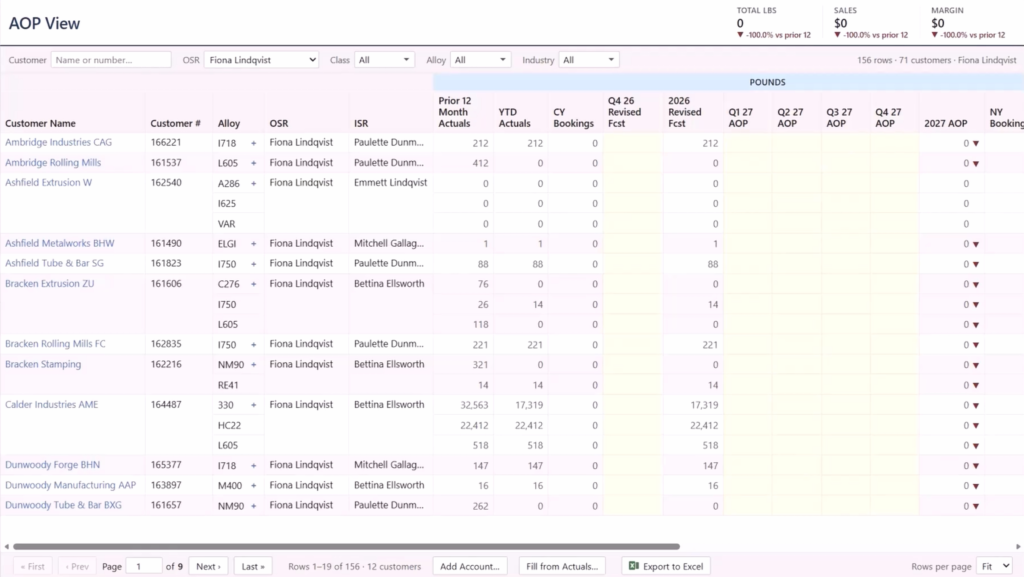
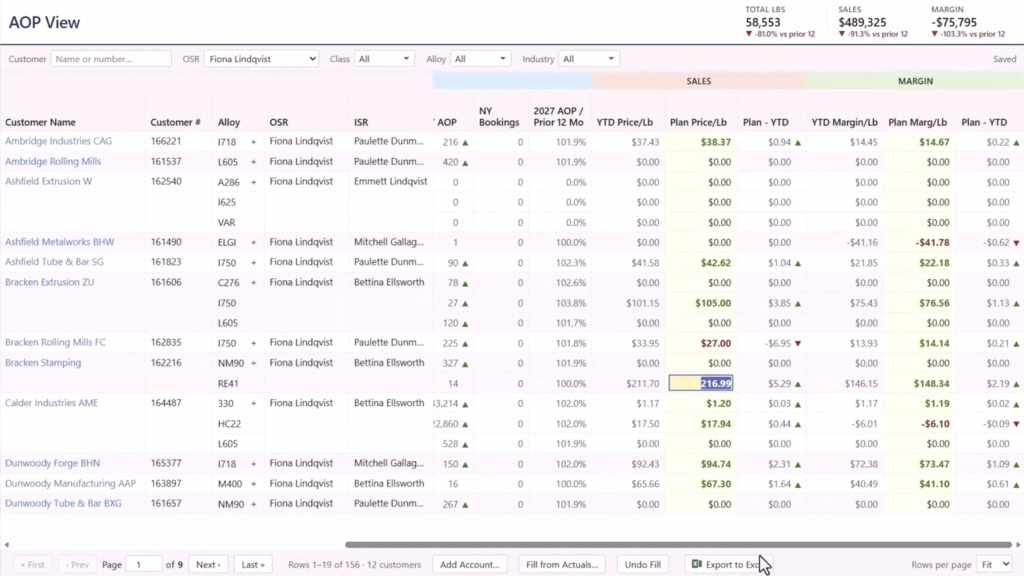
Instead of entering every number by hand, a salesperson can start from last year’s figures – quarterly volume, price per pound, margin per pound, any combination – bump them up by a percentage, and let the system spread that increase across the year according to the seasonality it already knows. One click, and most of the plan is filled in. From there, they’re really only reviewing the accounts that changed meaningfully, and a colored indicator makes it obvious at a glance when a number is trending the wrong way.
What Changed?
When they’re done, they’re done. They can export to Excel to slice the data further. The formulas carry over, but the numbers are already sitting exactly where they need to be. No re-entry, no handing spreadsheets back to accounting, no back-and-forth to make sure everyone’s working from the same version. All that’s left is a management sign-off.
This is one of several My Day dashboards we’ve built, each one designed around a specific role and the process that role actually runs. If Q4 at your company looks anything like this, we should talk.
Tell me the process your team hates most. In twenty minutes I’ll tell you whether a My Day view would fix it, and if it wouldn’t. https://go.oncehub.com/P2StrategySession